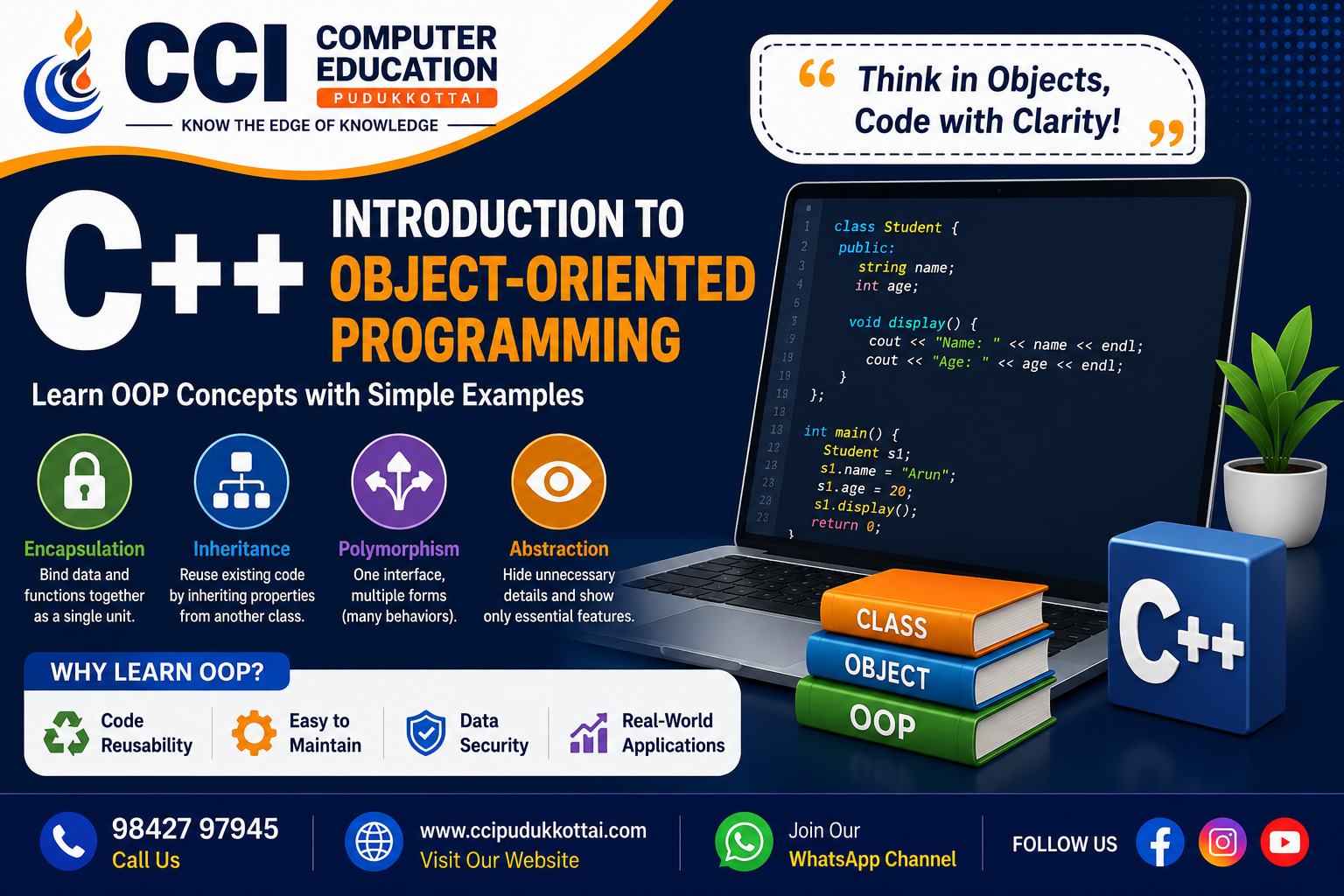
C++ Introduction to Object-Oriented Programming – Learn OOP Concepts with Simple Examples
Published: 01 Sep, 2026 | Author: CCI Admin | Category: C++ / Programming
Object-Oriented Programming, commonly known as OOP, is one of the most important concepts in C++ programming. OOP helps developers organize programs using objects and classes, making large applications easier to design, manage, and maintain.
Instead of writing a program only as a collection of functions, Object-Oriented Programming focuses on creating objects that represent real-world entities such as students, employees, cars, bank accounts, and many other things.
What is Object-Oriented Programming?
Object-Oriented Programming is a programming approach where programs are designed using classes and objects.
A class acts as a blueprint, while an object is an actual instance created from that blueprint.
For example, consider a Student Management System. A Student class can contain information such as student name, age, course, and methods to display student details.
Why is OOP Important in C++?
OOP helps developers create structured and reusable programs. It is widely used when developing large software applications.
- Helps organize large programs.
- Encourages code reusability.
- Makes programs easier to maintain.
- Supports real-world problem solving.
- Improves code security.
- Reduces code duplication.
What is a Class in C++?
A class is a user-defined data type that groups variables and functions together. It acts as a blueprint for creating objects.
#include <iostream>
using namespace std;

class Student {
public:
    string name;
    int age;
};
In this example, Student is a class containing two variables: name and age.
What is an Object?
An object is an instance of a class. Once a class is created, multiple objects can be created from that class.
#include <iostream>
using namespace std;

class Student {
public:
    string name;
    int age;
};

int main() {

    Student s1;

    s1.name = "Arun";
    s1.age = 20;

    cout << s1.name << endl;
    cout << s1.age;

    return 0;
}
Here, s1 is an object of the Student class.
Class and Object – Simple Real-World Example
Think of a class as a blueprint for building a house. The blueprint is not the actual house, but it contains the design and structure.
Similarly, an object is the actual house created using that blueprint.
- Class: Blueprint
- Object: Actual item created from the blueprint
Four Main Concepts of OOP
Object-Oriented Programming is mainly based on four important concepts.
1. Encapsulation
Encapsulation means combining data and functions into a single unit. A class is an example of encapsulation.
It also helps protect data by controlling how variables can be accessed.
class BankAccount {
private:
    double balance;

public:
    void setBalance(double amount) {
        balance = amount;
    }
};
2. Inheritance
Inheritance allows one class to acquire properties and functions from another class.
It helps developers reuse existing code instead of writing the same code again.
class Animal {
public:
    void eat() {
        cout << "Animal is eating";
    }
};

class Dog : public Animal {
};
Here, the Dog class can access the eat() function from the Animal class.
3. Polymorphism
Polymorphism means "many forms". It allows the same function or operation to behave differently depending on the situation.
Two common types of polymorphism are:
- Compile-time Polymorphism
- Run-time Polymorphism
4. Abstraction
Abstraction means hiding unnecessary implementation details and showing only the important features to the user.
For example, when driving a car, we use the steering wheel and pedals without needing to understand all the internal engine mechanisms.
Simple C++ OOP Program
Let's create a simple Student class with variables and a function.
#include <iostream>
using namespace std;

class Student {
public:
    string name;
    int age;

    void display() {
        cout << "Name: " << name << endl;
        cout << "Age: " << age;
    }
};

int main() {

    Student s1;

    s1.name = "Rahul";
    s1.age = 21;

    s1.display();

    return 0;
}
Real-World Applications of OOP
Object-Oriented Programming is used in many real-world software applications.
- Student Management Systems
- Banking Applications
- Hospital Management Systems
- Online Shopping Applications
- Games and Game Development
- Desktop Applications
- Mobile Applications
- Large Enterprise Software
Advantages of Object-Oriented Programming
- Code can be reused.
- Programs become easier to maintain.
- Large projects can be organized efficiently.
- Data can be protected using encapsulation.
- Inheritance reduces duplicate code.
- Programs can represent real-world objects.
- OOP supports modular programming.
Class vs Object
| Class | Object |
|---|---|
| A blueprint or template | An instance of a class |
| Defines properties and behavior | Uses the properties and behavior |
| Does not represent a physical entity | Represents an actual entity |
Tips for C++ Beginners Learning OOP
- First understand classes and objects clearly.
- Practice creating multiple objects.
- Learn constructors after classes and objects.
- Understand access modifiers such as public and private.
- Practice inheritance with simple examples.
- Learn polymorphism step by step.
- Build small real-world projects using OOP.
Frequently Asked Questions (FAQ)
1. What is OOP in C++?
OOP stands for Object-Oriented Programming. It is a programming approach that uses classes and objects to organize code and represent real-world entities.
2. What are the four pillars of OOP?
The four main concepts of Object-Oriented Programming are Encapsulation, Inheritance, Polymorphism, and Abstraction.
3. What is the difference between a class and an object?
A class is a blueprint or template, while an object is an actual instance created using that class.
4. Why is OOP important?
OOP helps developers organize large programs, reuse code, protect data, and create software based on real-world objects.
5. Is C++ an object-oriented programming language?
Yes. C++ supports Object-Oriented Programming concepts including classes, objects, inheritance, encapsulation, polymorphism, and abstraction.
6. What should I learn first before studying OOP in C++?
Beginners should understand basic C++ concepts such as variables, data types, operators, conditions, loops, arrays, and functions before moving to Object-Oriented Programming.
7. What is the easiest OOP concept to learn first?
Classes and objects are usually the best starting point. Once these concepts are understood, students can gradually learn constructors, encapsulation, inheritance, polymorphism, and abstraction.
8. Where is OOP used in real life?
OOP is used in banking software, student management systems, hospital applications, e-commerce platforms, games, desktop software, and many other large applications.
Learn C++ Through Practical Training
At CCI Computer Education, Pudukkottai, students can learn C++ programming through simple explanations, coding practice, and project-based learning.
Students can begin with C++ fundamentals and gradually learn functions, arrays, pointers, Object-Oriented Programming, data structures, and practical software development concepts.
Conclusion
Object-Oriented Programming is an important part of C++ programming. Understanding classes and objects provides a strong foundation for learning advanced concepts such as inheritance, polymorphism, encapsulation, and abstraction.
Start with simple examples, practice creating classes and objects, and gradually build small real-world projects. Strong OOP knowledge can help students write better organized and reusable programs.
What's Next?
In our next C++ tutorial, we will explore Constructors in C++ and learn how constructors are used to initialize objects automatically.
Related CCI Blogs
Call: 98427 97945 | Website: ccipudukkottai.com | WhatsApp Channel: Join Now
Share: Facebook | WhatsApp | Twitter